Category Archives: Uncategorized

July for Health Plans

A family on a couch depicting people looking for health plans in the fallFor health plans, July and August are the “pre-season” for the fourth quarter (Q4). This is the critical window to align data, creative assets, and logistics before the Medicare Annual Enrollment Period (AEP) begins on October 15 and ACA Open Enrollment starts November 1.

Success in Q4 is rarely won in October; it is won during the quiet planning months of late summer. Here is what you should be doing right now:

1. Data Hygiene & Advanced Segmentation
Before a single stamp is licked, the data must be scrubbed. For plans serving the Greater Houston and East Texas areas, demographic shifts are frequent.

Identify “Age-Ins”: Pull lists of individuals turning 65 in Q4 and Q1 of next year. These are your highest-value Medicare leads.

Loss of Subsidy/Redetermination Tracking: For Medicaid-focused plans, July and August are vital for identifying members who may lose eligibility and need to transition to a Marketplace (CHIP/ACA) plan in Q4.

Clean the “NCOA” (National Change of Address): Texas has seen significant internal migration. Ensure your mailing lists are updated to avoid “Return to Sender” waste, which can eat 10–15% of a budget if ignored.

2. Creative Strategy: The “Wellness” Warm-up
Direct mail in Q4 is often high-pressure sales. Use July and August for educational, non-sales touchpoints to build “brand warmth.”

Back-to-School Mailers: August is prime time for immunization reminders and sports physicals. This reinforces the “provider of choice” status before parents consider switching plans in November.

Social Determinants of Health (SDOH): Use this time to mail resources regarding food security or transportation. This builds trust, making the recipient more likely to open a renewal or enrollment packet in Q4.

3. Compliance & CMS Review
For Medicare Advantage plans, the regulatory clock is ticking.

ANOC/EOC Prep: Annual Notice of Change (ANOC) and Evidence of Coverage (EOC) documents must be sent by late September. Use August to finalize these complex documents and ensure they meet the latest CMS 2026 marketing guidelines.

Multi-Language Versions: In the Houston market, ensure your Spanish and Vietnamese versions are translated and legally vetted now. Waiting until September for translation often leads to errors and filing delays.

By treating July and August as the foundation, health plans can ensure their Q4 mailers are  timely, trusted resources for Texas families.

THE USPS RATE CHANGES SUMMARY – July 2026

The new postage rates take Effect on July 12, 2026. Plan for approximately a 5% postage increase. Of course, postage varies by mail type and presort/automation level. Here is the bottom line on what is changing, how it affects your wallet, and how to protect your delivery deadlines.

First-Class
A standard 1-ounce letter stamp is increasing to $0.82. If you use a postage meter at your office, it rises to $0.78. Postcards are moving to $0.65 for stamps.

Marketing Mail & Nonprofits
Marketing letters will average around 37¢ to 43¢ depending on how clean your mailing list is and how close to the recipient destination the mail is dropped. A good baseline for budgeting nonprofit letter rates is between 14¢ and 22¢.

Logistics & The USPS Modernization Plan
The USPS is currently in the middle of an extensive 10-year modernization initiative called Delivering for America. As part of this plan, they are shutting down smaller, outdated sorting centers and routing all mail through large, high-tech regional processing super-hubs. This structural overhaul has dramatically reduced reliance on air cargo in favor of an optimized ground transportation network. Because of this shift to ground transportation, distance now dictates your delivery speeds:

      • Local Mail- If your mail is delivering within a 3-hour regional drive of the drop location, your mail should deliver within 1 to 2 days after the drop date.
      • Long-Distance Mail- Because cross-country mail is traveling by truck, the delivery window has widened to 3 to 5 business days. If you have time-sensitive mailings—like healthcare open enrollment or dated event invites—the need to plan ahead is crucial. Plan on mailing 5 days earlier than you used to.

What’s Next
With the July 12 update locked in, rates are stabilized for the rest of the year. However, industry buzz and recent USPS filings indicate the Post Office is looking to transition permanently to an annual dual-adjustment schedule. This means you should prepare for a smaller, secondary rate adjustment in January 2027, followed by a primary increase next summer. Mapping out your multi-quarter budget right now is your absolute best defense against these shifting costs.

Fall Timelines
Because this is an election year, processing networks will be heavily flooded with political mailings during the 3rd and 4th quarters. Combined with the post office’s strict new ground-delivery standards, early planning is vital. Smart marketers will plan ahead to secure breathing room in mailboxes before the fall election-season surge.

The bottom line is simple: rates are going up, delivery timelines are shifting and fall capacity will be tighter than ever. The best thing you can do right now is get your campaigns planned, your lists cleaned, and your production scheduled before summer ends. The good news is that none of this has to be complicated. With the right planning partner and a clear production calendar, you can lock in your costs, protect your delivery windows, and stay ahead of every rate change on the horizon. Reach out to our team today and let’s map out your mailing strategy before the fall rush begins.

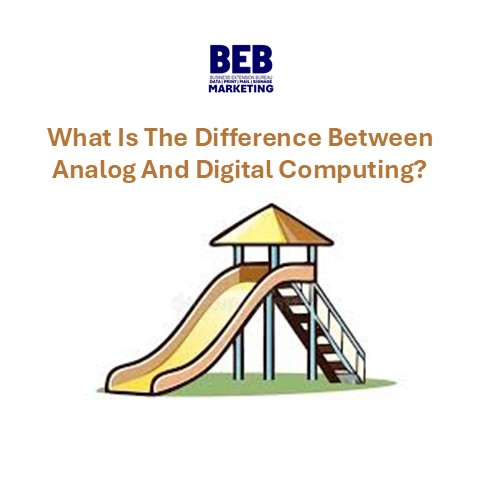
What Is The Difference Between Analog And Digital Computing?

The simplest way to think about the difference is to imagine the difference between a slide and a staircase.

1. Analog: The “Slide” (Continuous)
Analog computing works with a continuous flow of information. Think of a traditional dimmer switch for your lights. You can slide it to any position to get an infinite variety of brightness levels. There isn’t just “on” or “off”—there is every possible shade in between. It uses physical quantities like voltage, pressure, or even the position of a gear to measure. It’s “vibe” is like a mercury thermometer. The liquid rises and falls smoothly. You don’t see numbers jumping; you see a constant, moving line. Analog is incredibly fast at solving complex physics problems because it is a physical system. It’s also “noisy.” If the room gets hot or the machine vibrates, the results might shift slightly which makes it hard to get the exact same answer twice.

2. Digital: The “Stairs” (Discrete)
Digital computing breaks everything down into separate, distinct steps. Think of a standard light switch. It is either On or Off. There is no “halfway” state that the computer recognizes. It measures by using bits (0s and 1s). Everything—your favorite song, this text, a 4K movie—is chopped up into billions of these tiny “on/off” instructions, like a digital clock. The time jumps from 10:01 to 10:02. There is no visual representation of the seconds sliding by between them. Digital computing is incredibly precise and reliable. You can copy a digital file a million times, and the last copy will be identical to the first. The downside is to represent something smooth (like a high-definition photo), it has to use a massive amount of “steps” (pixels) to trick your eye into not seeing the jagged edges.

Analog is like drawing a circle with a pencil in one smooth motion. Digital is like drawing that same circle using thousands of tiny dots.

The Tangible Advantage in a Digital Age

In an era of overflowing email inboxes and constant digital noise, direct mail is experiencing a significant resurgence. Consumers, including millennials and Gen Z, often perceive physical mail as more trustworthy and personal than digital communication, with one study finding that 60% of millennials consider information in direct mail more useful than email. This tangibility allows brands to literally “cut through the clutter,” capturing undivided attention for over two minutes, compared to mere seconds for a digital ad. A well-designed, physical piece can create a lasting impression and a strong emotional connection that digital channels struggle to replicate.

The primary benefit of this tangibility is enhanced engagement and response rates. Direct mail campaigns consistently boast higher average response rates than digital channels, especially for house lists. Furthermore, it acts as a powerful initial touchpoint, driving recipients to take online actions such as visiting a website (57%), searching for the brand online (53%), or making a purchase (36%). This ability to prompt offline-to-online action makes it a crucial component of an integrated, high-impact marketing strategy that leverages the strengths of both physical and digital mediums.

Why Online Content Disappears and What It Means for Us

In today’s digital age, the internet serves as a massive repository of information, connecting users worldwide to a wealth of resources. However, a recent analysis by the Pew Research Center sheds light on the fleeting nature of online content.

A staggering quarter of webpages created between 2013 and 2023 are no longer accessible as of October 2023. This phenomenon of “digital decay” is prevalent across various online platforms, with news websites, government sites, and even Wikipedia pages experiencing broken links and disappearing content.

The Pew Research Center’s study also delved into social media and found that nearly one-in-five tweets become inaccessible within just a few months of being posted. Accounts are often suspended or deleted, leading to the disappearance of tweets from public view.

The implications of this digital decay are significant. It raises questions about the permanence of online information and the reliability of sources in our digital landscape. As users, we must be aware of the transience of online content and take measures to preserve and protect valuable information for future generations.

The internet may be an ever-expanding universe, but it’s essential to recognize that content can vanish in an instant. Let’s start a conversation about the preservation of online information and the impact of digital decay on modern society.

It’s a Sign!

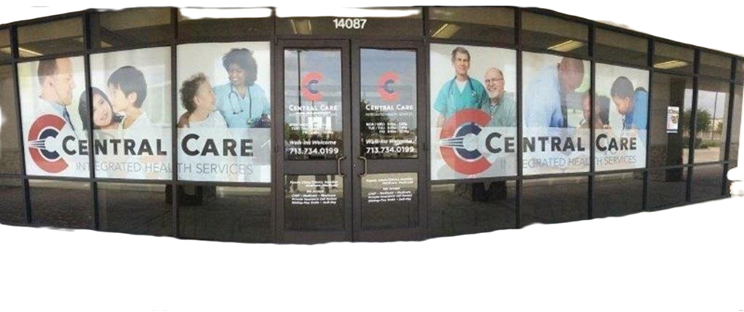
Signage plays a crucial role in enhancing marketing efforts by effectively communicating messages to potential customers. From storefronts to trade shows, well-designed signage grabs attention, conveys brand identity, and promotes products or services. With strategic placement and eye-catching designs, signage can attract foot traffic, increase brand visibility, and differentiate businesses from competitors. Clear and concise signage can also guide customers through physical spaces, improving their overall experience and encouraging conversions. Whether it’s a bold banner, an illuminated billboard, or creative window displays, signage serves as a powerful tool in shaping perception, creating brand recognition, and driving sales.

We can accommodate all sizes, complexities, and quantities to meet your signage needs, call us for your next signage project!