Author Archives: bebtexas

July for Health Plans

A family on a couch depicting people looking for health plans in the fallFor health plans, July and August are the “pre-season” for the fourth quarter (Q4). This is the critical window to align data, creative assets, and logistics before the Medicare Annual Enrollment Period (AEP) begins on October 15 and ACA Open Enrollment starts November 1.

Success in Q4 is rarely won in October; it is won during the quiet planning months of late summer. Here is what you should be doing right now:

1. Data Hygiene & Advanced Segmentation
Before a single stamp is licked, the data must be scrubbed. For plans serving the Greater Houston and East Texas areas, demographic shifts are frequent.

Identify “Age-Ins”: Pull lists of individuals turning 65 in Q4 and Q1 of next year. These are your highest-value Medicare leads.

Loss of Subsidy/Redetermination Tracking: For Medicaid-focused plans, July and August are vital for identifying members who may lose eligibility and need to transition to a Marketplace (CHIP/ACA) plan in Q4.

Clean the “NCOA” (National Change of Address): Texas has seen significant internal migration. Ensure your mailing lists are updated to avoid “Return to Sender” waste, which can eat 10–15% of a budget if ignored.

2. Creative Strategy: The “Wellness” Warm-up
Direct mail in Q4 is often high-pressure sales. Use July and August for educational, non-sales touchpoints to build “brand warmth.”

Back-to-School Mailers: August is prime time for immunization reminders and sports physicals. This reinforces the “provider of choice” status before parents consider switching plans in November.

Social Determinants of Health (SDOH): Use this time to mail resources regarding food security or transportation. This builds trust, making the recipient more likely to open a renewal or enrollment packet in Q4.

3. Compliance & CMS Review
For Medicare Advantage plans, the regulatory clock is ticking.

ANOC/EOC Prep: Annual Notice of Change (ANOC) and Evidence of Coverage (EOC) documents must be sent by late September. Use August to finalize these complex documents and ensure they meet the latest CMS 2026 marketing guidelines.

Multi-Language Versions: In the Houston market, ensure your Spanish and Vietnamese versions are translated and legally vetted now. Waiting until September for translation often leads to errors and filing delays.

By treating July and August as the foundation, health plans can ensure their Q4 mailers are  timely, trusted resources for Texas families.

250 Years Ago Today

As we approach our nation’s 250th Birthday over the weekend, we thought we would tap into what was happening today, July 1, 1776.

It was arguably the most stressful and pivotal day in the history of American independence—even more so than the 4th. Here’s what was happening:

1. The Great Debate
The Second Continental Congress reconvened at the Pennsylvania State House (now Independence Hall). On the floor was the Lee Resolution, which stated that the colonies “are, and of right ought to be, free and independent States.” John Dickinson of Pennsylvania gave a powerful, hours-long speech against independence, arguing that the colonies were “braving the storm in a skiff made of paper” and weren’t ready for war. John Adams rose to give the rebuttal. Though no transcript exists, witnesses described his speech as “the power of thought and expression” that moved the room toward revolution.

2. The Failed “Preliminary” Vote
At the end of the day, a trial vote was taken to see where the colonies stood. The results were disastrous for those hoping for a united front; 9 Colonies voted Yes. 2 Colonies (Pennsylvania and South Carolina) voted No. Delaware was deadlocked (split 1-1). New York abstained because they hadn’t received instructions from home. Because the delegates wanted a unanimous vote to show Great Britain they were a single, unbreakable front, they postponed the final vote until the next day, July 2.

3. Caesar Rodney’s Midnight Ride
Realizing Delaware was deadlocked, delegate Thomas McKean sent a frantic message to the third Delaware delegate, Caesar Rodney, who was at his home 80 miles away. Upon receiving the news on the night of July 1, Rodney began a legendary midnight ride through a thunderstorm to reach Philadelphia in time to break the tie the following morning.

4. Military Tension in New York
While the politicians debated in Philadelphia, the war was becoming very real in New York City. General George Washington was watching the British fleet arrive in New York Harbor. On July 1, more than 100 British ships were sighted off Sandy Hook—the largest expeditionary force Great Britain had ever sent abroad. The contrast was stark: 50 men in a room in Philadelphia were declaring independence while 30,000 British soldiers were preparing to stop them by force.

If you had asked a delegate on the evening of July 1, 1776, if the United States would exist by the end of the week, many of them would have been too worried about the “No” votes and the British Navy to give you a confident answer.

THE USPS RATE CHANGES SUMMARY – July 2026

The new postage rates take Effect on July 12, 2026. Plan for approximately a 5% postage increase. Of course, postage varies by mail type and presort/automation level. Here is the bottom line on what is changing, how it affects your wallet, and how to protect your delivery deadlines.

First-Class
A standard 1-ounce letter stamp is increasing to $0.82. If you use a postage meter at your office, it rises to $0.78. Postcards are moving to $0.65 for stamps.

Marketing Mail & Nonprofits
Marketing letters will average around 37¢ to 43¢ depending on how clean your mailing list is and how close to the recipient destination the mail is dropped. A good baseline for budgeting nonprofit letter rates is between 14¢ and 22¢.

Logistics & The USPS Modernization Plan
The USPS is currently in the middle of an extensive 10-year modernization initiative called Delivering for America. As part of this plan, they are shutting down smaller, outdated sorting centers and routing all mail through large, high-tech regional processing super-hubs. This structural overhaul has dramatically reduced reliance on air cargo in favor of an optimized ground transportation network. Because of this shift to ground transportation, distance now dictates your delivery speeds:

      • Local Mail- If your mail is delivering within a 3-hour regional drive of the drop location, your mail should deliver within 1 to 2 days after the drop date.
      • Long-Distance Mail- Because cross-country mail is traveling by truck, the delivery window has widened to 3 to 5 business days. If you have time-sensitive mailings—like healthcare open enrollment or dated event invites—the need to plan ahead is crucial. Plan on mailing 5 days earlier than you used to.

What’s Next
With the July 12 update locked in, rates are stabilized for the rest of the year. However, industry buzz and recent USPS filings indicate the Post Office is looking to transition permanently to an annual dual-adjustment schedule. This means you should prepare for a smaller, secondary rate adjustment in January 2027, followed by a primary increase next summer. Mapping out your multi-quarter budget right now is your absolute best defense against these shifting costs.

Fall Timelines
Because this is an election year, processing networks will be heavily flooded with political mailings during the 3rd and 4th quarters. Combined with the post office’s strict new ground-delivery standards, early planning is vital. Smart marketers will plan ahead to secure breathing room in mailboxes before the fall election-season surge.

The bottom line is simple: rates are going up, delivery timelines are shifting and fall capacity will be tighter than ever. The best thing you can do right now is get your campaigns planned, your lists cleaned, and your production scheduled before summer ends. The good news is that none of this has to be complicated. With the right planning partner and a clear production calendar, you can lock in your costs, protect your delivery windows, and stay ahead of every rate change on the horizon. Reach out to our team today and let’s map out your mailing strategy before the fall rush begins.

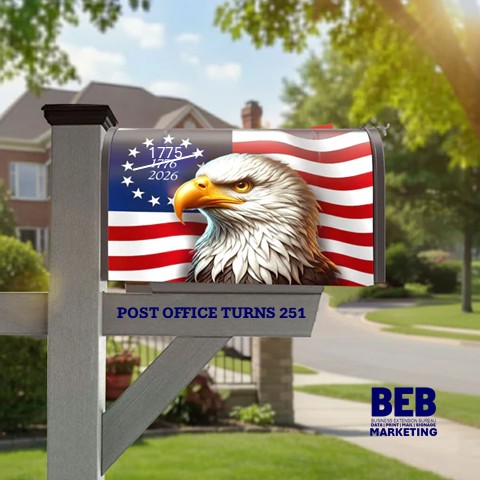
Post Office Turns 251

The “official” creation of the United States postal system actually has two major birthdates, depending on whether you are looking at its revolutionary roots or its formal legal establishment under the Constitution.

The Revolutionary Birth: 1775
The first iteration of a national postal system was created on July 26, 1775, by the Second Continental Congress. This was done to ensure reliable communication during the American Revolution, as the colonists no longer trusted the British “Parliamentary Post.” Benjamin Franklin was appointed the first Postmaster General. Because the post office was created in 1775, it is actually one year older than the United States itself!

The Constitutional Birth: 1792
While the service existed in various forms after the war, it was officially established as a permanent part of the federal government by the Postal Service Act, signed into law by President George Washington on February 20, 1792. This date matters because it formally created the Post Office Department .It established the principle of mail privacy, making it illegal for officials to open personal correspondence, and it set low rates for newspapers, effectively subsidizing the spread of news and information across the young nation—a cornerstone of early American marketing.

Special Note: The modern corporate structure of the Post Office Department was reorganized into the United States Postal Service (USPS) as an independent agency on July 1, 1971, following the Postal Reorganization Act signed by Richard Nixon.


Open Enrollment – 3 DM Trends

Success in 2026 isn’t just about the paper; it’s about the bridge to digital:

Tactile “Phygital” Integration: Include a prominent QR code that leads to a personalized landing page (PURL). In 2026, campaigns with QR codes see roughly 9% higher response rates than static mail.

The “Humanity” Aesthetic: Move away from stock photos of doctors. Use high-quality, matte-finish paper and “real” imagery that looks more like a high-end magazine than a bill. Physical mail now holds attention for an average of 1.6 minutes (vs. seconds for a digital ad).

Predictive Targeting: Instead of “Every Door Direct Mail” (EDDM), use predictive modeling to mail only to households that have a high probability of switching plans based on recent life events (turning 65, moving, or income changes).

Why the 2026 Timeline is Shifting
Be aware that for the 2027 plan year (enrolling in late 2026), many federal and state marketplaces are proposing shorter enrollment windows. While November 1st remains the start date, the “buffer” days in January are being reduced in many states. Your direct mail must hit harder and earlier in November to ensure you don’t miss the window.

OPEN ENROLLMENT Direct Mail = Zero Digital Fatigue

Direct mail in healthcare is one of the most effective ways to break through “digital fatigue,” but it requires significantly more lead time than an email blast. Because you are dealing with physical production, postal logistics, and strict regulatory windows, your direct mail strategy for 2026/2027 should follow a 12-to-16-week cycle.  For engagement and trust, direct mail consistently achieves significantly higher response rates and longer “shelf life” in the home—crucial factors for the complex, high-stakes decision-making required during Open Enrollment.

For the November 1st Open Enrollment (OE) kickoff, you should begin the direct mail process no later than July or August.

JUL – STRATEGY & LIST CLEANING
Define your audience. Scrub your mailing lists (NCOA updates) to avoid “return to sender” waste on expensive mailers.

AUG – DESIGN & COMPLIANCE
Create your layout. In healthcare, this must include a 2-week buffer for legal and CMS compliance reviews to ensure all disclaimers are accurate.

SEP – PRINTING & PRODUCTION
Send files to the printer. Using Variable Data Printing (VDP) allows you to personalize the recipient’s name and plan details, which is a top 2026 trend for higher ROI.

OCT 15-21 – FIRST IN-HOME DELIVERY
This is the “Education” piece. It should land just before the window opens to prime the recipient without being buried in the November “junk mail” rush.

DEC 1-5 – 2nd IN-HOME DELIVERY
The “Urgency” piece. Send a smaller postcard or “Final Notice” style mailer to drive action before the December 15 deadline for January 1 coverage.

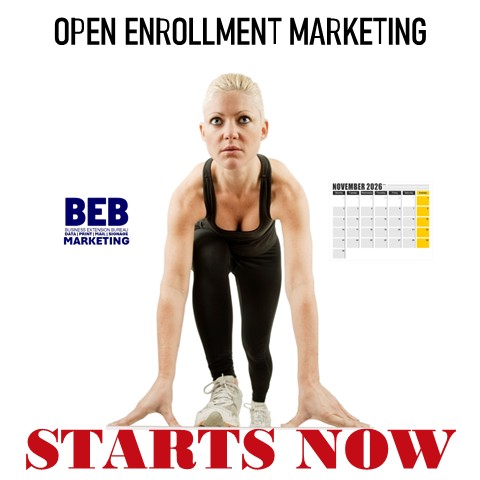
Open Enrollment Marketing Starts NOW!

In healthcare, preparation for Open Enrollment (OE) shouldn’t be a sprint; it’s a marathon that starts months before the first application is ever filed.

The planning phase for the 2027 enrollment season (which primarily begins in November 2026), should be in full swing by no later than June 2026.

Here is the strategic timeline to ensure your marketing is ready:
1. Planning Phase (May – June)
Audit Last Year: Analyze what worked in 2025-2026. Which channels (direct mail, social, email) had the lowest cost-per-acquisition?

Budgeting: Secure your spend. Remember that ad costs (CPC) typically spike in November and December as competition for “health insurance” keywords hits its peak.

Resource Alignment: Coordinate with brokers and internal teams to finalize plan details so your marketing materials are technically accurate.

2. Creative & Asset Development (July – August)
Content Production: Start filming those “authenticity” videos, User Generated Content-style. In healthcare, patient testimonials and “how-to-choose” guides perform exceptionally well.

Landing Page Optimization: Build and test your conversion funnels. Ensure they are mobile-first, as over 60% of healthcare research now happens on smartphones.

Compliance Review: Submit your creative for legal/regulatory approval early to avoid last-minute bottlenecks.

3. “Warm-Up” & Awareness (September – October)
Lead Magnets: Launch educational content like “The 2027 Guide to HSA vs. PPO” to capture emails and addresses (Zero-Party Data) before the enrollment window opens.

Remarketing Pixels: Start driving traffic to educational blogs so you can “tag” interested users and retarget them with direct enrollment ads in November.

Medicare Kickoff: Remember that Medicare Open Enrollment usually begins October 15, so if you serve that demographic, your “Go” button is two weeks earlier than ACA plans.

4. The Live Window (November 1 – January 15)
The Sprint: On November 1, shift from “education” to “action.” Use high-urgency messaging.

Deadlines Matter: Focus heavily on the December 15 deadline for January 1 coverage, as this is the biggest conversion spike of the year.

MILESTONES

  • Medicare Open Enrollment Oct 15, 2026 – Dec 7, 2026
  • ACA Open Enrollment Starts Nov 1, 2026
  • Deadline for Jan 1 Coverage Dec 15, 2026
  • ACA Open Enrollment Ends Jan 15, 2027 (standard)

Note: Some states (like California or New York) often extend their deadlines into late January. Always check your specific state exchange for variations.

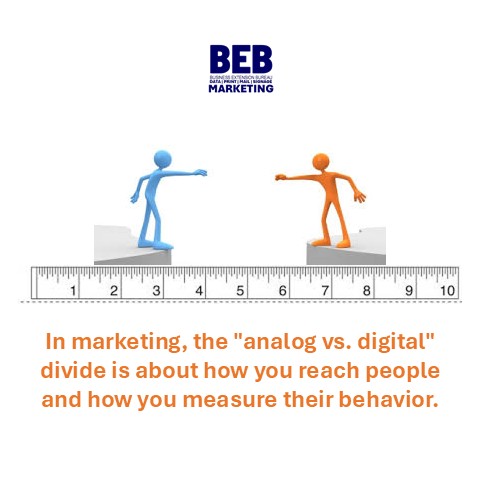
The “Analog vs. Digital” Divide in Marketing

In marketing, the “analog vs. digital” divide isn’t just about tech; it’s about how you reach people and how you measure their behavior. It’s the difference between a gut feeling and a data point.

1. Analog Marketing: The “Vibe” and the “Physical”
Analog marketing relies on physical mediums and continuous, non-quantifiable experiences. It’s “old school,” but it’s still incredibly powerful for brand building. Analog mediums include billboards, print magazines, direct mail, radio ads, and TV commercials (the traditional broadcast kind). You cast a wide net and hope to catch a mood and unfortunately, measurement is a bit fuzzy. If you put up a billboard on a highway, you know roughly how many cars passed it, but you don’t know exactly who looked at it or if it actually caused them to buy your product. It lacks the “precision” of a digital bit.

2. Digital Marketing: The “Data” and the “Direct”
Digital marketing breaks every interaction down into 0s and 1s—discrete, trackable events and uses social media ads, Search Engine Optimization (SEO), email marketing, and PPC (Pay-Per-Click). Every action is a “step.” A user either clicked the link (1) or they didn’t (0). They stayed on the page for 12 seconds (a discrete number) or they bounced. This offers high precision. You can target a 24-year-old in Houston who likes “vintage cameras” and “oat milk.” You can see exactly how much money you spent to get one single customer (Acquisition Cost).

3. The “Hybrid” Reality: The Best of Both Worlds
Most modern brands don’t choose just one; they use a hybrid approach. Analog for Brand Awareness using a beautiful, “smooth” analog experience (like a high-end pop-up shop or a glossy magazine spread) to build an emotional connection. Digital for Conversion: Using “precise” digital tools (like a retargeting ad on Instagram) to nudge that same person to finally click “Buy.”

Interestingly, Analog is making a comeback because the digital world is so “chopped up” and noisy, many brands are returning to analog tactics—like high-quality physical catalogs—to stand out. It’s harder to ignore a physical object than a digital banner ad.

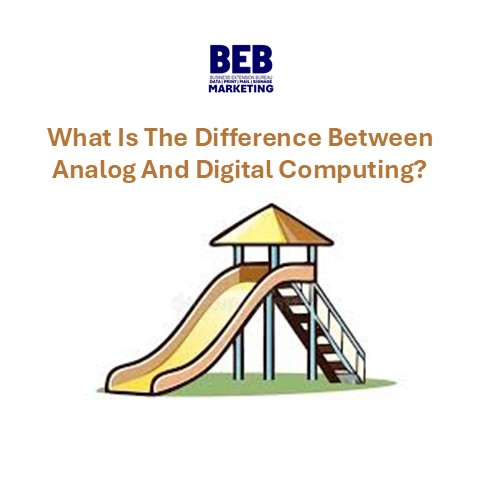
What Is The Difference Between Analog And Digital Computing?

The simplest way to think about the difference is to imagine the difference between a slide and a staircase.

1. Analog: The “Slide” (Continuous)
Analog computing works with a continuous flow of information. Think of a traditional dimmer switch for your lights. You can slide it to any position to get an infinite variety of brightness levels. There isn’t just “on” or “off”—there is every possible shade in between. It uses physical quantities like voltage, pressure, or even the position of a gear to measure. It’s “vibe” is like a mercury thermometer. The liquid rises and falls smoothly. You don’t see numbers jumping; you see a constant, moving line. Analog is incredibly fast at solving complex physics problems because it is a physical system. It’s also “noisy.” If the room gets hot or the machine vibrates, the results might shift slightly which makes it hard to get the exact same answer twice.

2. Digital: The “Stairs” (Discrete)
Digital computing breaks everything down into separate, distinct steps. Think of a standard light switch. It is either On or Off. There is no “halfway” state that the computer recognizes. It measures by using bits (0s and 1s). Everything—your favorite song, this text, a 4K movie—is chopped up into billions of these tiny “on/off” instructions, like a digital clock. The time jumps from 10:01 to 10:02. There is no visual representation of the seconds sliding by between them. Digital computing is incredibly precise and reliable. You can copy a digital file a million times, and the last copy will be identical to the first. The downside is to represent something smooth (like a high-definition photo), it has to use a massive amount of “steps” (pixels) to trick your eye into not seeing the jagged edges.

Analog is like drawing a circle with a pencil in one smooth motion. Digital is like drawing that same circle using thousands of tiny dots.

The Power of Physicality

As we look at the marketing landscape of 2026, one thing is certain: digital noise has reached a breaking point. While Artificial Intelligence has become the “invisible engine” behind campaign logistics and personalization, it has also created a sea of sameness. We see the 2026 trend shifting toward Hyper-Physicality. Consumers are fatigued by fleeting pixels; they are craving the weight of a premium mailer, the texture of a custom-branded gift, and the impact of bold, physical signage that anchors a brand in the real world.

The second major shift this year is the integration of “Analog Intelligence.” In 2026, direct mail is no longer a standalone tactic; it is a data-driven trigger. Leading brands are using AI to predict exactly when a customer needs a physical touchpoint, sending personalized, high-finish print pieces that bridge the gap between a digital browse and a physical purchase. There is a resurgence in specialty finishes—metallic inks and tactile textures—that demand attention in a way a “skip-able” digital ad never could.

Sustainability is no longer a “nice-to-have”; it is the baseline for brand trust. This year, promotional products and signage are being judged by their lifecycle. Trends have moved toward “Retail-Alignment,” where the swag people actually keep—like ethically sourced apparel and high-end, circular-economy tech—replaces disposable trinkets. Our clients are finding that a single, high-quality, sustainable item does more for brand loyalty than a hundred pieces of “stuff.” It’s about being intentional, not just being present.

Finally, 2026 is the year of Omnichannel Authenticity. Whether it’s a QR code on a piece of environmental signage or a personalized URL in a mailbox, the goal is a seamless transition between the physical and digital realms. As a 77-year-old company, BEB understands that while the tools change, the human need for connection remains constant. Success this year won’t go to the loudest brand, but to the one that uses every tool—from print to digital—to create a cohesive, trustworthy, and tangible experience