Tag Archives: USPS rate increase

USPS Shipping Price Increases for January, First-Class Stamps Unchanged

USPS Announces Shipping Price Increases for January 2026, First-Class Stamps Unchanged. The  United States Postal Service is adjusting its mailing prices next month. While the cost of a First-Class Mail stamp will remain unchanged for now, price adjustments for various shipping services will take effect on January 18, 2026.

These price changes will affect costs for everyday Americans and businesses that rely on USPS shipping services. The adjustments come as the organization works to generate necessary revenue and modernize its operations, navigating challenges like staffing shortages in regions including Maine, Texas, Kentucky, and Alabama, which have caused package and mail delays.

The upcoming USPS update will introduce specific price increases across key shipping categories:

  • Priority Mail service prices will rise by an average of 6.6%.
  • Priority Mail Express service will see a 5.1% increase.
  • USPS Ground Advantage prices will increase by 7.8%.
  • Parcel Select prices will go up by 6.0%.

According to the USPS, these new rates are designed to keep the Postal Service competitive  while providing the organization with needed revenue. The changes are part of a broader network modernization plan to support a financially sustainable future for the organization.
The governors of the United States Postal Service accepted a recommendation from Postmaster General David Steiner to temporarily forgo a price change for “Market Dominant products,” which include First-Class Mail stamps and other related services, until mid-year 2026.
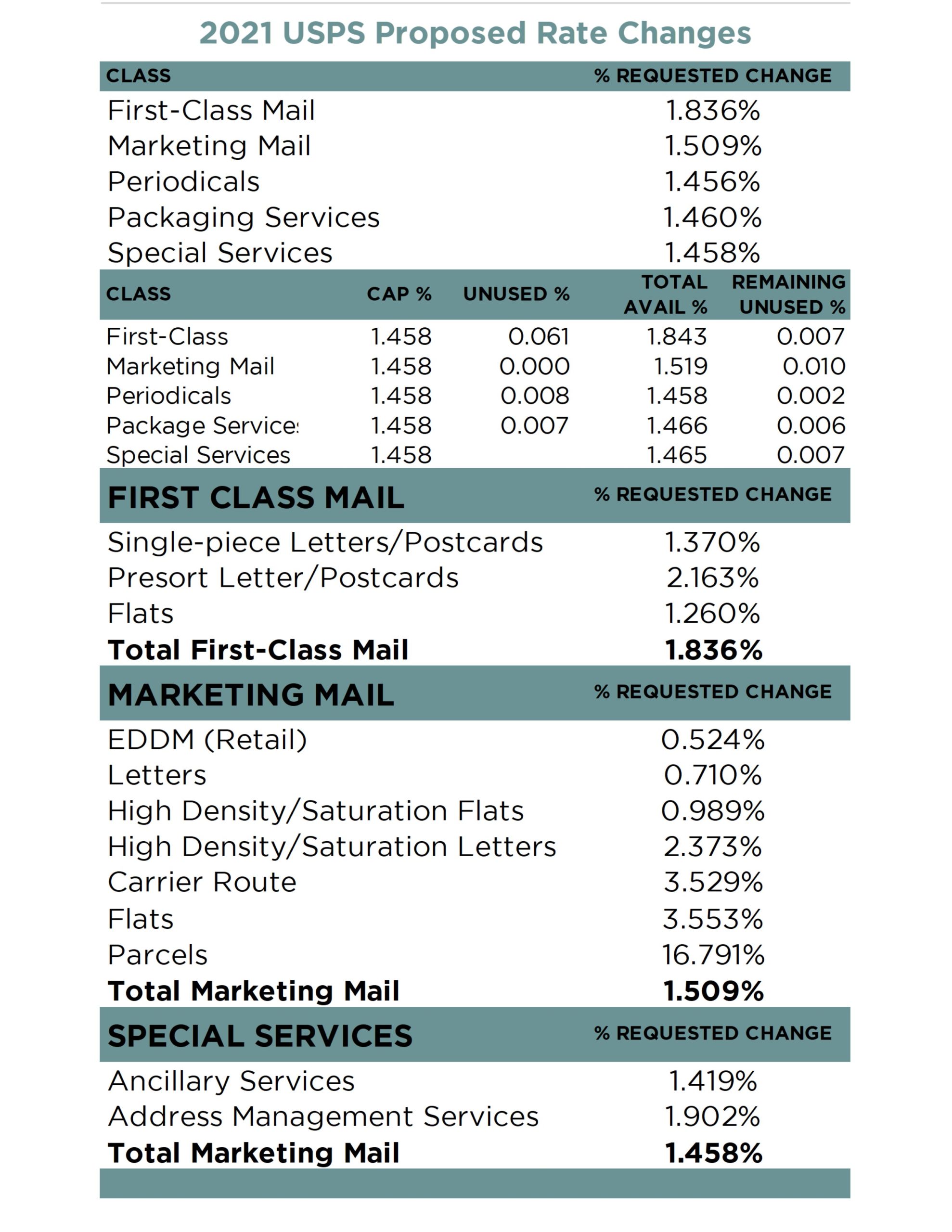

2021 USPS Proposed Rate Changes

On October 9th the USPS filed a request with the PRC (Postal Regulatory Commission) to revise pricing for market-dominant products.

The amount of the proposed increase by class reflects the USPS authority, under the CPI-based cap, plus any unused rate authority left over from previous price changes, that can be carried over. The USPS did not use all of its available rate authority, meaning that some of it will remain “banked” after this case and can be used in the future.

Below is an overview the upcoming rate case:

Click here to see a 2021/2020 Rate Comparison Chart.


PRC Rejects Proposed F/C Mail Increases

The PRC (Postal Regulatory Commission) has rejected the first-class rate increases that are scheduled to become effective Jan. 26, 2020.

In the Nov. 13 order, the commission stated that the proposed increases are in excess of what a price cap allows and directed the USPS to rework rates that apply to letters, postcards, printed papers and small packets weighing up to 2 kilograms coming into the United States from other countries.

The commission seems confident that the rates can be revamped in time for the planned rate change.

The commission calculated the planned first-class increases at 2.109 percent. This exceeds the 1.933 percent increase that is allowed.

The Postal Service’s board of governors is expected to revisit First-Class Mail prices, and any subsequent filing of revisions with the PRC will occur no later than Dec. 12.

Postmaster General Says No January Rate Increase

At a PostCom (Association for Postal Commerce) board member meeting last week, Postmaster General imagesPostmaster General Patrick Donahoe said that the Board of Governors would not seek an increase in mail and shipping product services in the upcoming new year.  As a result, current rates will stay in place during the extended holiday season and through the early part of 2015.

On September 9, oral arguments were held in the U.S. Appeals Court for the D.C. Circuit on the Postal Regulatory Commission (PRC) order, approving the emergency 4.3% exigent surcharge.  Uncertainty over whether the exigency will be temporary – as stipulated by the Postal Regulatory Commission in its approval of the rate increase – or will be built into the base rate influenced the board’s decision to wait, according to a statement issued by USPS.

Due to the delay, the earliest an increase could be seen would be late March or early April of 2015.