 For health-based nonprofits, August is the strategic “handoff” month where programmatic summer activities transition into the most intensive fundraising quarter of the year. Because health causes often tie their primary campaigns to specific awareness months (like Breast Cancer Awareness in October) or the tax-driven “giving season” in December, August is the time to finalize the data and creative infrastructure.
Here is what health-based nonprofit marketers should be working on in August 2026:
Before launching the heavy mail volume of Q4, August is the month for database hygiene:
- Have your mailer run your lists through National Change of Address (NCOA) and deceased suppression filters. In the health sector, sending an appeal to a deceased patient or donor is a significant brand risk.
- Use your CRM data to identify “Lapsed” vs. “Consistent” donors. In 2026, many nonprofits are using AI-driven modeling to identify donors most likely to increase their gift amount, allowing for higher-quality, personalized mailers for those specific segments.
- Ensure your “Patient” lists are HIPAA-compliant and separated from your “Philanthropy” lists unless they have explicitly opted in for fundraising.
Health-based fundraising relies on the “Patient Hero” narrative.
- Finalize the selection of the patient or family who will be the “face” of your 2026 Year-End appeal.
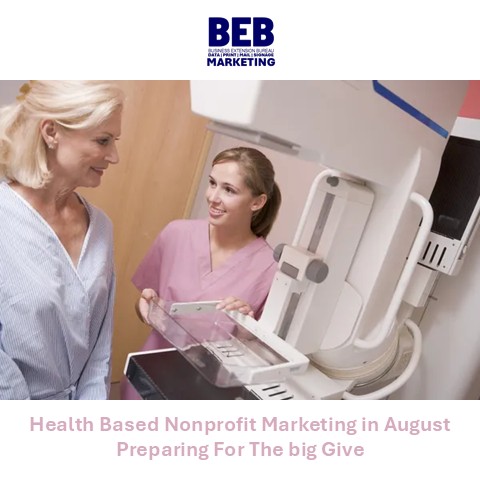
- August is the deadline for custom photography. You want authentic photos of your actual clinics or mobile units. Stock photos are increasingly ignored in 2026; donors respond to the “tactile reality” of your local impact.
- Calculate your “Impact Math” (e.g., “$150 = 1 Mammogram”). This needs to be finalized in August so it can be integrated into all print and digital assets.
Direct mail response rates in Q4 are significantly higher when a “Matching Gift” is involved.
- Spend August reaching out to major donors or corporate partners (like Houston’s energy or healthcare giants) to secure a “Challenge Match” for December.
- Once the match is secured, you can design your mailer envelopes with “2X YOUR IMPACT” callouts, which is one of the highest drivers of “open rates” in direct mail.
A successful direct mail campaign is not a standalone channel. August is when you map the OMNI-channel synchronization:
- Plan for the USPS “Informed Delivery” images. When a donor sees a grayscale image of your letter in their morning email, you should have a matching digital ad appear in their feed.
- Build and test the specific “Q4-Give” landing pages. Ensure they are mobile-optimized and support 2026 payment standards like Apple Pay, Venmo, and Google Pay to reduce friction for the donor
Consider a “August Gratitude” mailer. Before you ask for money in October or December, send a low-cost postcard in August that simply shares a success story from the summer. This “primes the pump” so that when your Year-End appeal arrives, the donor feels like they are already part of a continuous story of success rather than just a transaction.
For health-based nonprofits, August serves as the essential preparation phase for the high-stakes “double header” of October’s Awareness Month and the December year-end giving season. During this window, marketers must prioritize rigorous database hygiene to reduce wasteful postage. It is the final deadline for capturing authentic patient “hero stories” and high-quality local photography, which are critical for building the emotional trust required to drive Q4 conversions. By securing matching gift partners and synchronizing direct mail with digital “surround sound” tactics like Informed Delivery in August, organizations can bypass autumn production bottlenecks and ensure their mission-critical appeals stand out in a cluttered mid-term election and holiday mailbox.