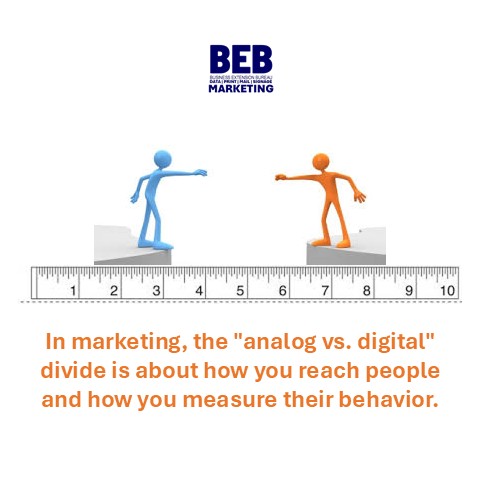
 In marketing, the “analog vs. digital” divide isn’t just about tech; it’s about how you reach people and how you measure their behavior. It’s the difference between a gut feeling and a data point.
1. Analog Marketing: The “Vibe” and the “Physical”
Analog marketing relies on physical mediums and continuous, non-quantifiable experiences. It’s “old school,” but it’s still incredibly powerful for brand building. Analog mediums include billboards, print magazines, direct mail, radio ads, and TV commercials (the traditional broadcast kind). You cast a wide net and hope to catch a mood and unfortunately, measurement is a bit fuzzy. If you put up a billboard on a highway, you know roughly how many cars passed it, but you don’t know exactly who looked at it or if it actually caused them to buy your product. It lacks the “precision” of a digital bit.
2. Digital Marketing: The “Data” and the “Direct”
Digital marketing breaks every interaction down into 0s and 1s—discrete, trackable events and uses social media ads, Search Engine Optimization (SEO), email marketing, and PPC (Pay-Per-Click). Every action is a “step.” A user either clicked the link (1) or they didn’t (0). They stayed on the page for 12 seconds (a discrete number) or they bounced. This offers high precision. You can target a 24-year-old in Houston who likes “vintage cameras” and “oat milk.” You can see exactly how much money you spent to get one single customer (Acquisition Cost).
3. The “Hybrid” Reality: The Best of Both Worlds
Most modern brands don’t choose just one; they use a hybrid approach. Analog for Brand Awareness using a beautiful, “smooth” analog experience (like a high-end pop-up shop or a glossy magazine spread) to build an emotional connection. Digital for Conversion: Using “precise” digital tools (like a retargeting ad on Instagram) to nudge that same person to finally click “Buy.”
Interestingly, Analog is making a comeback because the digital world is so “chopped up” and noisy, many brands are returning to analog tactics—like high-quality physical catalogs—to stand out. It’s harder to ignore a physical object than a digital banner ad.